With South Africans facing another significant electricity tariff increase, homeowners are once again looking for practical ways to reduce their monthly utility costs while improving energy security.
For many households, the biggest electricity consumer isn’t the stove, kettle, or washing machine — it’s the geyser.
In most homes, an electric geyser can account for between 30% and 50% of the monthly electricity bill. As electricity prices continue to rise, more homeowners are asking whether LPG gas is a better alternative.
This guide explains the advantages and disadvantages of LPG compared to electricity and helps homeowners decide which solution makes the most sense for their household.
Why More South Africans Are Switching to LPG
South Africa’s electricity costs have steadily increased over the past decade, while load shedding and power interruptions have forced homeowners to seek more reliable energy solutions.
LPG (Liquefied Petroleum Gas) has become one of the most popular alternatives because it can be used for:
- Water heating
- Cooking
- Indoor and outdoor heating
- Backup energy solutions
- Commercial applications
Among these, replacing an electric geyser with a gas geyser often delivers the biggest reduction in electricity consumption.
Gas Geyser vs Electric Geyser: Understanding the Difference
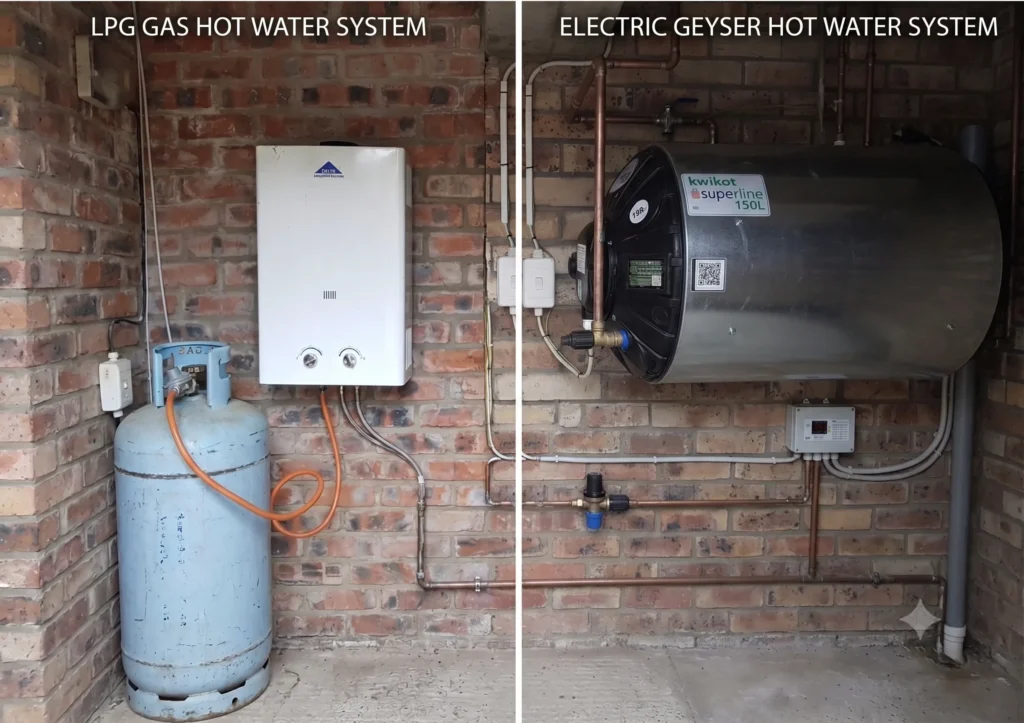
An electric geyser stores a large volume of water in a tank and continuously reheats it throughout the day to maintain temperature.
A gas geyser works differently. Instead of storing hot water, it heats water instantly when a hot tap is opened. This means energy is only used when hot water is actually needed.
Advantages of Installing a Gas Geyser
Lower Monthly Running Costs
For most households, the geyser is the single largest electricity consumer. A gas geyser:
- Only heats water when required.
- Eliminates standing heat losses.
- Reduces overall electricity consumption.
- Can significantly lower monthly energy costs.
For a family of four, the savings can be substantial, especially as electricity tariffs continue to rise.
Hot Water During Load Shedding
One of the biggest advantages of LPG is energy independence. A gas geyser with battery ignition or hydro ignition can continue supplying hot water even during:
- Load shedding
- Power failures
- Municipal outages
This means no cold showers when the power goes out.
Unlimited Hot Water
Unlike traditional electric geysers, a gas geyser does not need time to recover or reheat. Benefits include:
- Continuous hot water supply.
- Multiple consecutive showers.
- Better performance for larger households.
- Ideal for homes with high hot-water demand.
Faster Water Heating
Gas burners provide heat immediately. Homeowners benefit from:
- Instant hot water.
- No waiting for a storage tank to heat up.
- Improved convenience throughout the day.
Perfect Companion for Solar Systems
Many homeowners are installing solar systems to reduce reliance on the grid. By removing the electric geyser from the household electrical load, homeowners can:
- Reduce battery requirements.
- Reduce inverter sizing.
- Improve overall solar system efficiency.
- Extend battery backup time during outages.
This makes LPG one of the most effective ways to optimise a residential solar installation.
Disadvantages of a Gas Geyser
Higher Upfront Installation Cost
A compliant LPG installation generally requires:
- Gas geyser
- LPG cylinders
- Cylinder cage
- Regulator
- Gas piping
- Flue system (for indoor installations)
- Gas Certificate of Conformity (CoC)
- Additional plumbing work between the gas geyser and electric/solar geyser.
The initial investment is usually higher than simply replacing an existing electric geyser.
Gas Cylinder Refills
Unlike electricity, LPG must be replenished. Homeowners need to:
- Monitor gas usage.
- Arrange cylinder refills.
- Keep spare cylinders available.
Many households overcome this by installing two cylinders with a changeover regulator.
Maintenance Requirements
Regular inspections are recommended to ensure safety and efficiency. Maintenance may include:
- Leak testing
- Pressure testing
- Burner cleaning
- Regulator inspections
- Pipework inspections
- Flue checks
LPG vs Electricity: Which Is Cheaper?
The answer depends on:
- Local electricity tariffs
- LPG pricing
- Household hot-water consumption
- Family size
For a family of four using between 200 and 300 litres of hot water per day, a gas geyser often provides lower monthly operating costs while dramatically reducing electricity consumption.
The biggest financial advantage comes from eliminating one of the largest electrical loads in the home.
When Does a Gas Geyser Make Sense?
A gas geyser is usually the better option if:
- You experience regular load shedding.
- You want to reduce electricity costs.
- You already use LPG for cooking.
- You are installing solar power.
- You want continuous hot water.
- You are building or renovating a home.
When Does an Electric Geyser Make Sense?
An electric geyser may still be suitable if:
- Your existing geyser is relatively new.
- You have a large solar PV system producing excess energy.
- You prefer not to manage LPG refills.
- Budget constraints prevent a gas installation.
What Is the Best Gas Geyser Setup for a Family of Four?
For most South African households, a 16–20 litre per minute LPG gas geyser paired with:
- Two 48kg LPG cylinders.
- A manual changeover regulator.
- A compliant gas installation.
provides an excellent balance between performance, reliability, and operating cost.
This setup typically offers enough hot water capacity for multiple bathrooms while ensuring uninterrupted supply when one cylinder runs empty.
Final Verdict: Is LPG Worth It?
As electricity prices continue rising in South Africa, LPG offers homeowners a practical way to reduce their dependence on the grid while lowering overall electricity consumption.
A properly designed gas geyser installation can provide:
- ✓ Lower electricity usage.
- ✓ Hot water during load shedding.
- ✓ Unlimited hot water.
- ✓ Improved solar system performance.
- ✓ Greater energy independence.
For many homeowners, switching to LPG is no longer simply about convenience — it’s becoming an important long-term energy strategy.
If you’re considering a gas geyser installation, speak to our qualified LPG installers who can assess your household’s hot-water requirements and recommend the correct geyser and cylinder configuration. Get in touch with Stargas for a no-obligation assessment.